Glory Wee on Shaping the Future of Aviation for a Smarter, More Resilient Industry
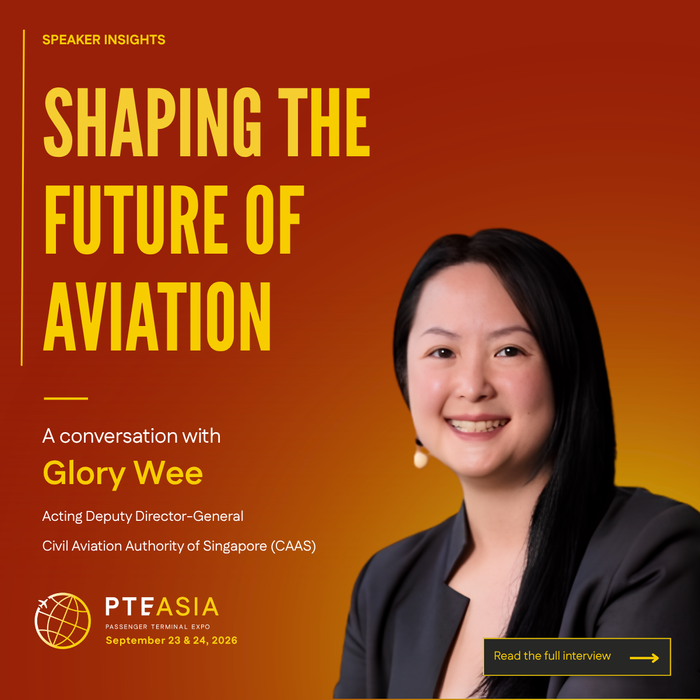
Ahead of PTE Asia, we spoke with Glory Wee, Acting Deputy Director-General, Civil Aviation Authority of Singapore (CAAS), who will open Day 2 of the Keynote Leadership Theatre with her presentation, “Shaping the Future of Aviation”.
1. Asia’s aviation sector is expanding rapidly, bringing both opportunities and growing pressures on airport infrastructure and operations. From your perspective, what are the most important challenges facing airports in the region today, and where do you see the greatest opportunities for transformation?
The growth opportunity for aviation in Asia is tremendous. The International Civil Aviation Organization projects that global air passenger traffic will almost triple over the next 25 years, with Asia Pacific accounting for about half of this growth.
For airports in our region, the challenge is not whether aviation will grow, but how we can accommodate that growth whilst continuing to deliver a safe, efficient and great passenger experience.
Three challenges stand out.
The first is capacity. Many airports in Asia are already operating in increasingly constrained environments, and others are planning major expansions. But building infrastructure takes time, land and significant investment. So, airports need to think not just about adding capacity, but also about how existing and future capacity can be used more productively and intelligently.
The second is manpower. Aviation remains a highly labour-intensive sector. As traffic grows, simply increasing the workforce in proportion to passenger volumes will not be tenable, especially for countries like Singapore that face labour constraints. So, we need to redesign jobs, automate physically demanding tasks, and enable our workers to take on higher-value roles.
The third is resilience. Airports today have to contend with a much wider range of disruptions, from extreme weather and supply chain shocks to cybersecurity threats and operational disruptions. And because aviation is so interconnected, a disruption in one part of the system can quickly have knock-on effects elsewhere.
These challenges also create significant opportunities for transformation. Technology will be a major enabler. Artificial intelligence (AI), automation, robotics and better use of data can help airports improve productivity, optimise flows and respond more effectively to disruptions. However, technology alone will not transform airports. Transformation requires technology to be complemented by better process design, better job design and better infrastructure design.
This is especially important for new airports and terminals. Infrastructure built today will shape how airports operate for decades. If airports are designed from the onset to support automation, digital systems and new operating concepts, transformation downstream becomes much easier. The opportunity in Asia is therefore not simply to build larger airports to accommodate more passengers. It is to build smarter, more productive and more resilient airports that can continue to evolve as aviation grows.
2. The PTE Asia conference programme focuses on six core pillars. Which of these areas are you addressing? Drawing on your presentation and experience, can you highlight some key ideas, insights, strategies or solutions relevant to the Asian market?
My presentation on “Shaping the Future of Aviation”, focuses on three interconnected areas that will be particularly important for airports in Asia: digitalisation, automation and future-ready infrastructure.
The first is digitalisation.
The airport of the future will become progressively more intelligent, using data to understand what is happening across the airport, predict what may happen next and support better decision-making. AI will accelerate this shift, but data is its foundation. Airports will therefore need strong digital backbones and the ability to bring together information that today may sit across different organisations and systems. Done well, technology should remove friction from the passenger journey and allow airport workers to focus their time and attention on interactions where the human touch matters most.
The second area is automation.
Robotics, autonomous vehicles and other forms of automation can help aviation workers become more productive while improving the consistency and resilience of airport operations. However, automation should not simply be layered onto existing processes. If we automate yesterday’s processes, we may simply make an inefficient process run faster. Organisations need to redesign the work itself, transforming processes, jobs and skills so that people and technology complement one another.
The third area is future-ready infrastructure.
Airports are long-lived assets, and decisions made today can shape operations for 30, 40 or even 50 years. Infrastructure therefore needs to be designed with sufficient flexibility to accommodate technologies and operating concepts that may not yet exist. This means thinking early about digital connectivity, automation, utilities, space requirements, climate resilience and how different parts of the airport may need to evolve over time.
These three areas are closely connected. Digitalisation enables smarter operations. Automation allows those operations to scale. And good infrastructure design creates the physical environment in which both can flourish. For Asia, this is particularly important because so much new aviation infrastructure will be built over the coming decades. We have a unique opportunity to embed transformation into these airports from the onset rather than retrofit it later.
While it is impossible to predict exactly what aviation will look like in 2050, airports can be designed with sufficient adaptability to ensure they continue to evolve and remain relevant as that future unfolds.
Join Glory Wee on Day 2 of PTE Asia in the Keynote Leadership Theatre for “Shaping the Future of Aviation” as she explores what that future could look like.